
Back to Blog
Arbitrage Betting Explained
August 10, 2026
Most betting strategies ask you to be right more often than you’re wrong. Arbitrage betting doesn’t, it pays out no matter who wins.
That sounds like a trick, but it isn’t. It’s simple math, applied to the fact that different bookmakers don’t always agree on the same match. This guide walks through exactly how that works, with two real matchups as examples, and why arbitrage is harder to keep doing than it looks on paper.
What is Arbitrage Betting
Every betting price has its own probability. Arbitrage betting (sometimes called a “surebet“) happens when you add up the implied probabilities of every possible outcome across different bookmakers, and the total comes out under 100%.
When that happens, you can bet on every outcome, split across the right bookmakers in the right amounts, and you come out ahead regardless of the result. It isn’t a prediction. It’s a gap between what different books are willing to pay.
Why These Price Gaps Exist
Bookmakers don’t all update at the same speed. A sharp book like Pinnacle, which takes on large, informed bettors, tends to move its prices quickly and accurately. A soft bookmaker, built more for casual betting volume, can be slower to react to news, or simply price a match differently based on its own customer base.
Promotions cause gaps too. A bookmaker boosting a price to attract new customers can accidentally create a mismatch against the rest of the market.
None of these gaps last long. Once enough bettors find one, the odds move back into line. That’s the whole reason speed matters in arbitrage betting.
A Two-Outcome Example: Tennis Arbitrage
We use this example to see how arbitrage works in a sport with only two possible outcomes, no draw to account for.
Our example: a hypothetical Sinner vs Alcaraz match, using round numbers to keep the math easy to follow.
Book A prices Sinner to win at 1.83.
Book B, pricing the same match slightly differently, offers Alcaraz at 2.30.
Add up the implied probability of each side: 1 ÷ 1.83 is about 54.6%, and 1 ÷ 2.30 is about 43.5%. Together that’s 98.1%, under 100%. That gap is the arbitrage.
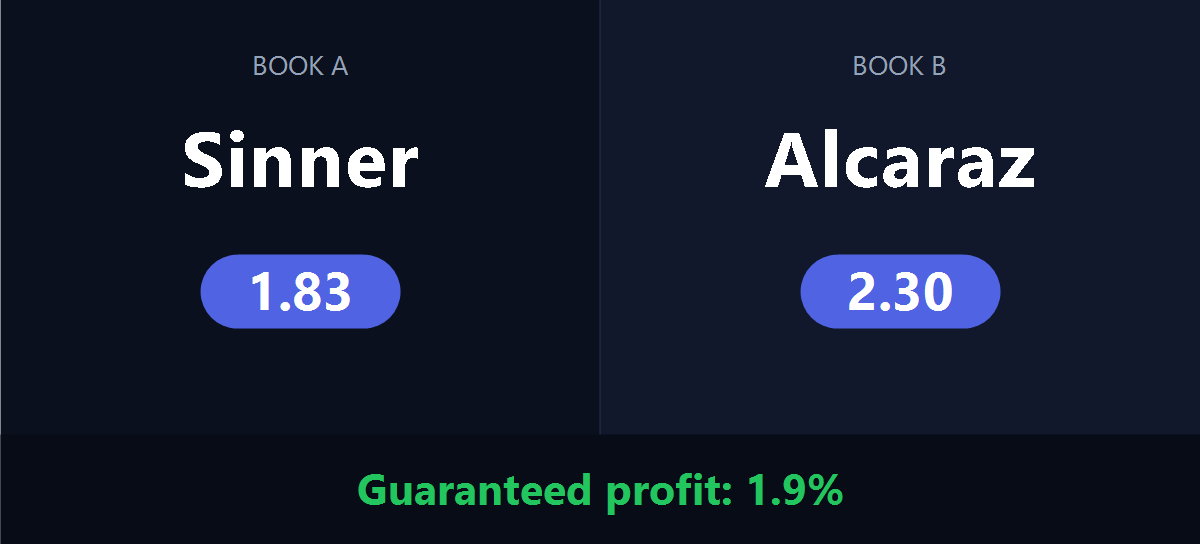
If you split a €100 stake across both sides in proportion to those probabilities: about €55.70 on Sinner at Book A, and about €44.30 on Alcaraz at Book B.
If Sinner wins, €55.70 × 1.83 pays back about €101.90.
If Alcaraz wins instead, €44.30 × 2.30 also pays back about €101.90. Either way, a guaranteed profit of about €1.90 on €100, roughly 1.9%.
The takeaway: the payout is the same no matter who wins, because the stake split was built to make it identical. That’s the entire mechanism, just applied to two real numbers instead of one.
A Three-Outcome Example: Football Arbitrage
Our example: a hypothetical Barcelona vs Real Madrid match, again with round, illustrative numbers.
Imagine three different bookmakers each offer their best price on one outcome:
Book A has Barcelona to win at 2.30
Book B has the Draw at 3.60
Book C has Real Madrid to win at 3.70.
Implied probabilities: Barcelona 43.5%, Draw 27.8%, Real Madrid 27.0%. Added together, that’s 98.3%, again under 100%.
Splitting €100 across all three in proportion: about €44.24 on Barcelona, €28.26 on the Draw, and €27.50 on Real Madrid.
Check all three outcomes: Barcelona winning pays €44.24 × 2.30, about €101.75. A draw pays €28.26 × 3.60, also about €101.75. Real Madrid winning pays €27.50 × 3.70, again about €101.75. Same result, three different ways to get there, a guaranteed profit of about €1.75 on €100, roughly 1.75%.

The takeaway: adding a third outcome doesn’t change the logic, it just adds a third bookmaker and a third slice of the stake. The formula is the same, whether there are two outcomes or three.
The Catch: Why Arbitrage Has an Expiry Date
Two real numbers ruin arbitrage betting more than anything else: time and account limits.
- Time: The gap between Book A’s price and Book B’s price only exists until one of them corrects it. Placing both bets takes time, and if a price moves before your second bet lands, the guaranteed part disappears.
- Account limits: Bookmakers exist to make money on their own customers, not to fund arbitrage bettors. Betting patterns that only ever land on the profitable side of a mismatch get noticed, and accounts that show this pattern repeatedly tend to get limited or closed. This is the biggest reason arbitrage isn’t a strategy you can scale forever on any one bookmaker.
Neither of these makes arbitrage worthless. It just means the two numbers, speed and account longevity, matter as much as finding the gap in the first place.
Arbitrage vs Value Betting
Arbitrage and value betting both start from the same idea, comparing a price against what it should really be. Where they split is risk.
- Arbitrage removes risk entirely by betting every outcome, in exchange for a small, fixed profit and a strategy that bookmakers actively try to shut down.
- Value betting accepts that any single bet can still lose, in exchange for a bigger long-term edge on one side of the market, one that’s far harder for a bookmaker to detect or limit against. Our Value Betting for Beginners guide covers that side of the coin in full.
Where BetUnfair Fits Into This
Finding an arbitrage gap by hand means watching odds across multiple bookmakers at once, on multiple matches, and catching the moment they misalign before it closes. That isn’t realistic to do manually.
BetUnfair’s built-in Arbitrage tool takes the prices you’re looking at and tells you instantly whether a guaranteed-profit combination exists, and exactly how much to stake on each side if it does. Dropping Odds Alerts fire in under 5 seconds when a tracked price moves, across 9 sharp books and 15 or more soft books, so a gap opening up doesn’t depend on you refreshing a page at the right moment.
Pricing starts at €27 a month, with a 5-day free trial and a 1-month money-back guarantee if you don’t turn a profit.
FAQ
What is arbitrage betting in simple terms?
Betting every possible outcome of the same match across different bookmakers, in amounts calculated so you come out ahead no matter which outcome happens.
Is arbitrage betting guaranteed to work?
The math guarantees the outcome only if both bets are placed at the prices used to calculate the stakes. If a price moves before you finish placing both legs, the guarantee can disappear.
Is arbitrage betting illegal?
No. It’s a legal use of publicly available prices. Bookmakers dislike it and may limit accounts that do it often, but placing the bets themselves isn’t against the law.
How is arbitrage different from value betting?
Arbitrage bets every outcome for a small, guaranteed profit. Value betting accepts the risk of losing a single bet in exchange for a larger long-term edge that’s harder for a bookmaker to detect.
Why do bookmakers limit arbitrage bettors?
Because an account that only ever bets the profitable side of a price mismatch never loses in the way a typical customer does, which is easy for a bookmaker to spot in its own data.
Do I need a big bankroll to start?
No. The profit percentage stays the same regardless of stake size, so the strategy works at €100 the same way it works at €10,000, the only difference is how much profit that percentage turns into.
Try It Yourself
Start your free 5-day BetUnfair trial at betunfair.io and see BetUnfair’s Arbitrage tool check real prices for a guaranteed-profit combination, on any match you’re already watching.
Keywords: arbitrage betting explained · how does arbitrage betting work · surebet betting strategy · sports arbitrage example · arbitrage betting risks · two-way arbitrage betting · three-way arbitrage betting · is arbitrage betting profitable · arbitrage vs value betting · sports betting arbitrage calculator · odds monitoring platform