
Back to Blog
Champions League Outright Odds: How to Calculate Vig
November 17, 2026

To calculate overround on Champions League outright odds, divide 1 by each team’s decimal odds, add the implied probabilities, and subtract 100%.
In the hypothetical eight-team tournament-winner market below, the probabilities add up to 116.99%, giving an overround of 16.99 percentage points. The three longest prices contribute 14.37 points combined.
How Do You Convert Decimal Odds to Implied Probability?
Divide 1 by the decimal odds and multiply by 100 to get a percentage.
At decimal odds of 2.00, a winning €100 bet returns €200. That’s your €100 stake back plus €100 in profit. A loss costs you €100. So if you win one bet and lose one, the profit and loss cancel out. That’s why you need to win 50% of the time to break even.
At 2.50, a winning €100 bet earns €150 in profit, while a loss still costs €100. Over five bets at that price, two wins earn €300 and three losses cost €300. Two wins out of five is 40%, so that’s the break-even win rate.
Suppose both sides of a two-way market are priced at 1.90. Divide 1 by 1.90 and you get 52.63% for each side. Add the two probabilities and you get 105.26%. Subtract 100% and you get an overround of 5.26 percentage points.
How Do You Calculate Overround on a Champions League Winner Market?
Imagine a sportsbook pricing the eight remaining clubs to win the tournament before the quarterfinals. The odds below are hypothetical. To find each club’s implied probability, divide 1 by its decimal odds.
| Selection | Decimal odds | Implied probability |
| Favorite | 3.00 | 33.33% |
| Team 2 | 4.00 | 25.00% |
| Team 3 | 5.00 | 20.00% |
| Team 4 | 7.00 | 14.29% |
| Team 5 | 10.00 | 10.00% |
| Team 6 | 15.00 | 6.67% |
| Team 7 | 21.00 | 4.76% |
| Team 8 | 34.00 | 2.94% |
| Total | 116.99% |
The first five teams alone add up to 102.62%. The last three add another 14.37 percentage points, bringing the full board to 116.99%. Subtract 100% from that full total and you get an overround of 16.99 percentage points.
How Do You Calculate No-Vig Odds on an Outright?
Divide the favorite’s implied probability of 33.33% by 1.1699, the full board total of 116.99% written as a decimal. That gives an estimated no-vig probability of 28.49%. To convert that probability back to decimal odds, divide 1 by 0.2849 to get 3.51.
Suppose your own analysis gives the favorite a 30% chance of winning. That’s above the no-vig estimate of 28.49%, but the offered price of 3.00 still requires a win rate of 33.33% to break even.
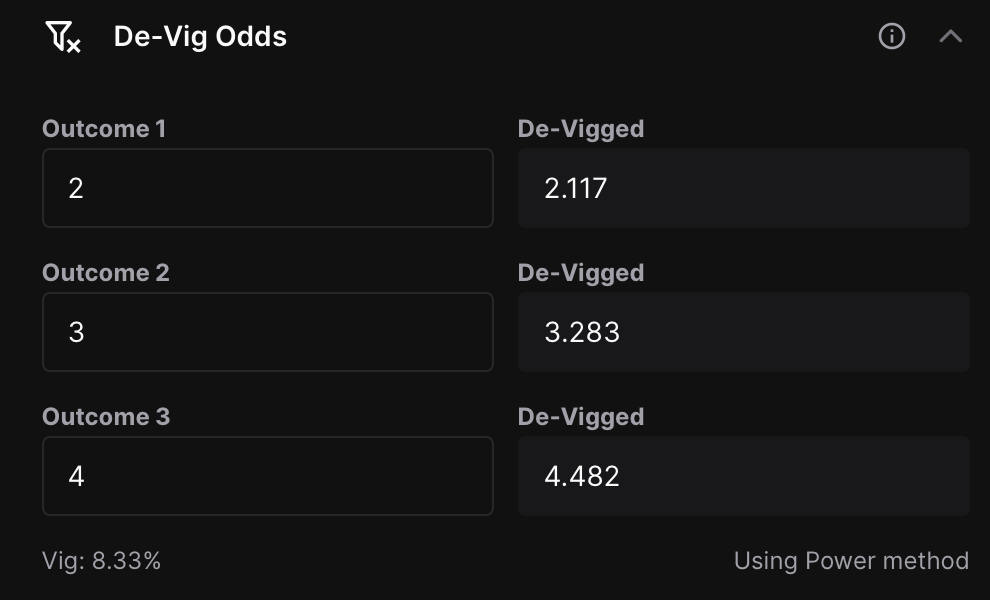
BetUnfair De-Vig tool. This three-way match example uses the Power method to remove the vig from odds of 2.00, 3.00, and 4.00. The eight-team outright example above uses the proportional method.
For a walkthrough of the Margin and De-Vig calculators, see BetUnfair’s Quick Tools guide.
How Do You Evaluate a Long Shot?
Team 8 is priced at 34.00. With €1 bets at that price, one win returns €34, including your stake. That covers the €34 you would spend on 34 bets, so you need to win once in 34 bets to break even. That’s about 2.94%. If you estimate Team 8’s chance at 2%, you’d expect about one win in 50 comparable bets. At that win rate, the price is too short to break even.
Do Dropping Odds Mean the Overround Has Changed?
A contender’s outright odds can shorten after the knockout draw if its path to the final looks easier. The shorter price raises that team’s implied probability. Other teams’ prices may have moved too, so compare the full winner board before and after the draw to see whether the overround changed.
If you’re comparing two sportsbooks, take each full board from around the same time and check that both markets settle on the same outcome. For an example of tracking price movements in individual matches, see BetUnfair’s Dropping Odds Alerts.
FAQ
What is an outright bet?
An outright bet is a bet on the winner of an event or competition, such as the team that lifts the Champions League trophy.
Is a 20% overround the same as losing 20% on a bet?
A 20% overround means the prices imply probabilities that add up to 120%. Your expected return on an individual bet depends on the odds you take and the team’s actual chance of winning.
Do you need every selection to calculate overround?
Yes. Use every selection from the same sportsbook’s winner market. If the book offers an “Any Other Team” option, include it once at its quoted price.
Does removing the vig give you the true odds?
It gives you an estimate. Different de-vig methods can produce different fair prices from the same board because they make different assumptions about how the margin is distributed.