
Back to Blog
Low Limits, Loud Odds: How to Tell a Real Move From a Manipulated One
August 28, 2026
Not every odd movement means something. On a market with a small betting limit, one bettor placing the maximum bet a few times in a row can push the price around on their own, with no real information behind it at all. The odds move, an alert fires, and it looks exactly like a genuine sharp signal except nothing actually changed about the match.
Once you know what that pattern looks like on a graph you stop chasing moves that were never real signals to begin with and you start paying more attention to the moves that actually are. That’s what this blog is about.
What a Limit Tells You
Every market has two numbers worth watching, not just one: the odds and the limit (the maximum amount the bookmaker will currently accept on that market). Most people only ever look at the odds, but the limit is what tells you how much money to put behind a move.
A sharp book like Pinnacle doesn’t open every market with full confidence:
- Testing the Market: On a match nobody’s tested with real money yet they start with a small limit to gather information without taking on much risk.
- Building Confidence: As bets come in and the book gets a clearer read on where the true price should sit they raise the limit. Sometimes this happens several times over a day.
A market with a $50 limit and a market with a $500 limit are not the same kind of market, even if the odds on both just moved by the exact same amount.
That gap matters because a small limit is easy to push around. If the max bet is $50, someone only needs a small amount of money to hit that max and shove the price wherever they want it. If the limit is $500, doing the same thing costs ten times as much. Manipulating a market gets expensive fast once the limit grows. That’s exactly why it tends to stop happening once it does.
Why Would Someone Do This?
It’s worth asking why anyone would spend money moving a price on a small, low-profile match in the first place. A few reasons:
- Cross-Platform Arbitrage: Moving the price on one book to make a bet look more attractive on a different platform before that platform catches up.
- Probing Market Depth: Testing how a thin market reacts to see how far a small amount of money can push a line before the book notices and pulls back.
- Uninformed Max Betting: Noise from a bettor with a strong opinion and no real edge, throwing repeated max bets at a market simply because the max is small enough to matter.
No matter the reason behind it, the pattern looks the same every time. The price jumps around a lot while only a few people are betting. Then, as soon as real money starts coming into the market, that jump disappears.
A Real Example: Queen of the South FC vs. Hibernian B
This Scotland Challenge Cup match between Queen of the South FC and Hibernian B works well as an example: low profile, small betting interest, and low opening limits on Pinnacle across every market on the board.
1. Over 3.5 Total Goals

This market opened at 1.79, with the limit at about 150. Almost right away, the limit dropped a lot, and it kept bouncing between 50 and 90 for a long time.
- The Volatility: The odds jumped many times for a long time, between 1.68 and 2.59. This is the normal sign of a market with very little money in it, where a few people betting the biggest amount allowed can push the price around each time.
- The Stabilization: Around midday, the limit went up to 150 to 180. Right after that, the odds stayed close together in a tight range.
- Late Shift: Right before kickoff, the odds jumped to 2.06 and the limit spiked too. This late move could mean real news about the team came out. Or it could mean someone made one last expensive try to move the odds. The margin was high, at 8.25%. That high margin is proof that there was not much money in this market overall.
2. Under 3.5 Total Goals

The mirror market (Under 3.5 goals) shows the exact same pattern. It opened at 1.91, with a limit of 222. Then the limit dropped and the market went through a rollercoaster phase with low limits, where the odds swung between 1.36 and 2.03. Once the limit went back up, the odds settled down too, ending at 1.68.
Both sides of the total goals line moved in the same way. This confirms that the big price swings were caused by low overall money in the market, not by something specific about one outcome being more likely.
3. Home Moneyline
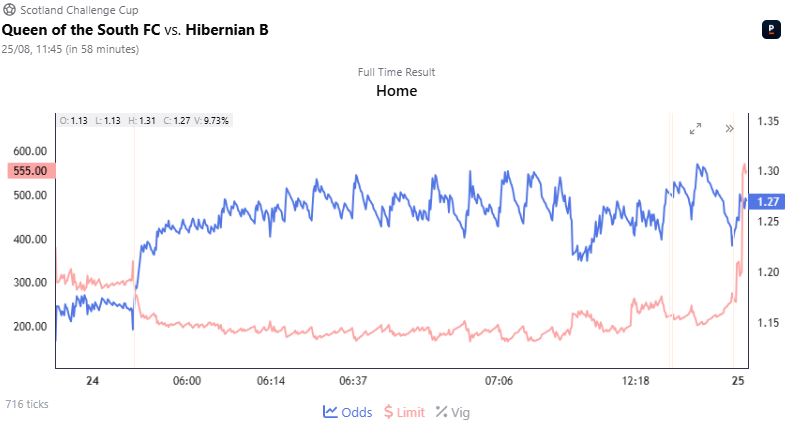
The Home moneyline opened at 1.13, with a limit of 555. The limit dropped early on, then climbed back up. During that stretch, the odds bounced around in a choppy range, between 1.13 and 1.31, before settling at 1.27. The margin here was 9.73%. That is the highest of the three markets, which matches the big gap between the opening price and the final limit.
What This Actually Means for You
The lesson isn’t to avoid low-limit markets. A lot of real value shows up in small, overlooked matches. The lesson is “watch the limit before you trust the odds.”
- Small Limit + Big Swing: Weak evidence. Likely one bettor with a moderate bankroll, not genuine market repricing.
- Large Stable Limit + Big Swing: Strong evidence. Moving a high-limit market requires real capital and conviction.
Before you act on a dropping odds alert or a big price jump, check what the limit is doing. If the limit is small and jumping around treat it as noise. If the limit has increased and has stabilized, a move at that point is very likely to be real because it would be really expensive to fake.
FAQ
What does the limit on a betting market actually mean?
It’s the maximum amount the bookmaker will currently accept on that specific market. It is separate from the odds and moves on its own timeline, sometimes changing several times over a single day.
Why do bookmakers start with small limits on some matches?
Usually because it’s a low-profile match without much betting data. A small limit lets them test the market without taking on significant risk while refining the true price.
Can someone really move the odds without any real information?
Yes, if the limit is small enough. Repeatedly betting the maximum on a thin market shifts the price simply because there isn’t enough opposing liquidity to absorb it.
Why do the odds calm down after the limit goes up?
Two things happen at once: the book trusts its price more (taking bigger bets without reacting sharply), and market manipulation becomes too expensive to maintain.
Does a big odds move always mean something real happened?
No. Check the limit at the same time. A big move next to a small, unstable limit is weak evidence compared to the same move next to a large, steady limit.
Is this only relevant for lower-league or obscure matches?
It is most visible there, but the principle applies to any market that opens with small limits, including niche player props or early-released lines on major fixtures.
Try It Yourself
Start your free 5-day BetUnfair trial at betunfair.io and monitor real-time market limits alongside odds movements across all major books.
Keywords: low limit betting markets · pinnacle limit manipulation · reading odds graphs · sharp bookmaker limits explained · odds manipulation thin markets · betting limit vs odds movement · dropping odds low liquidity market · how bookmakers set betting limits · Scotland Challenge Cup betting example · odds volatility explained