
Back to Blog
Reverse Line Movement in the NFL
October 25, 2026
Every NFL Sunday, the same kind of screenshot goes around. One side has most of the bets, but the line moves the other way. People call that reverse line movement, and some call it a lock. It isn’t a lock. It’s a clue and most of the screenshots that get passed around don’t show you enough to read it right.
Why the Split Happens?
Ticket percent counts the number of bets on a side. Money percent counts the actual dollars. A $10 bet and a $10,000 bet both count as one ticket, so a crowd of small bettors can fill up the ticket count on the favorite while a handful of larger bets quietly own most of the actual money on the other side. When those two numbers disagree, you get reverse line movement: most tickets sit on one side, but the line moves toward the other.
Key numbers matter here too. Three and seven are common NFL winning margins, so a line crossing 3 or 7 carries more weight than a move from 5.5 to 5. Books don’t give up a half point on a key number without a real reason.
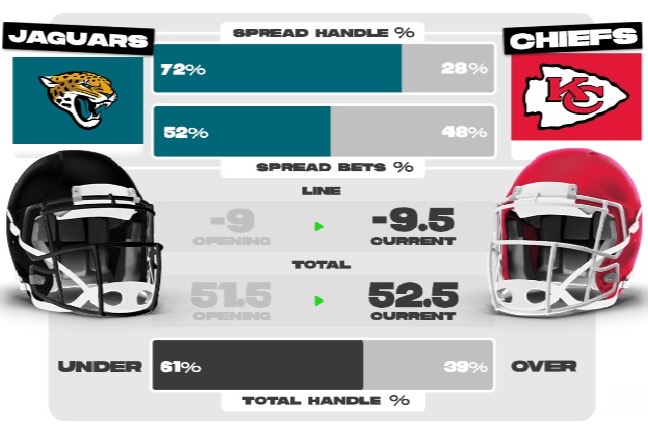
Here’s a real graphic example of that gap for a Jaguars at Chiefs game showing 72% of the spread handle on the Jaguars, but only 52% of the spread bets, a nearly even ticket split. Despite the heavier money sitting on the Jaguars, the line moved from Chiefs -9 at open to Chiefs -9.5 at close, the opposite direction that money would suggest. We’re using this chart to show what the pattern looks like on a real split, not to claim we know exactly what drove that specific move.
RLM Is Not a Guaranteed Bet
Treat it as one read, not a signal to bet blindly. Books move lines for several reasons, and sharp money is only one of them:
- Sharp action. Respected bettors hit one side hard enough to move the price.
- Liability. A book adjusts because of its own exposure, not because the wider market changed its mind.
- Market following. Many books just copy the move from a few market-making books, without any new information of their own.
- News. Injuries, weather, and lineup changes move lines fast, and some of that news reaches the market before it reaches the screenshot you’re looking at.
- Shading. A book sometimes prices a popular side worse on purpose, expecting the public to bet it anyway regardless of the number.
The line move tells you the book changed its price. It doesn’t always tell you why, and the “sharp money” explanation is only one of five.
Read Splits With Care
Public betting splits are useful, but limited, for three reasons worth keeping in mind every time you see one.
Splits are time-stamped. A screenshot from Thursday can look nothing like the market on Sunday morning, so always check when the numbers were actually pulled before you act on them.
Books differ from each other. One book’s splits reflect only its own customers and a book full of casual players will show a very different split than one that takes real sharp action. A single source is never the whole market.
Sources rarely show their method. Some sites publish splits from one book, others blend several together without saying so. Treat any single split you see as one data point, not a verdict.
Watch the Line, Not Just the Split
A split is a report about bettors. The line itself is the book’s actual price and that’s the part worth watching closer.
A few habits help here. Note both the opening number and the current one, so you can see how and when it moved. Look specifically for moves that go against heavy ticket counts, since that’s the real core of reverse line movement. Check the news before crediting sharp money for a move an injury report could just as easily explain. And track your own closing line value over time: if you consistently beat the closing number, your reads are probably correct, regardless of how any single split looked beforehand.
BetUnfair’s Bet Tracker logs the price you got on every bet next to the closing line, so you can see your real closing line value building up over time instead of guessing at it after the fact. And our Graph Center charts odds movement across books, so you can see when a number moved and which books moved first, instead of guessing from a single data point.
See line movement across books in the Graph Center at betunfair.io.
FAQ
Does reverse line movement always mean sharp money is on that side?
Not always. It often points that way, but books also move lines for their own liability, breaking news, or because they’re just copying a market-making book.
Why do key numbers matter for NFL line moves?
A lot of NFL games are decided by a margin of 3 or 7 points. A line crossing one of those numbers changes a bet’s value more than most other moves do.
Are public betting splits accurate?
They reflect one source at one point in time. Different books show different splits, so always check the time stamp and consider the source before trusting a number.
Should I bet every reverse line move I see?
No. Treat it as one input among several. Confirm it with the full line history, a comparison across books, and a check of the recent news before deciding it means anything.
Keywords: reverse line movement · ticket percent vs money percent · NFL betting splits · sharp money explained · key numbers NFL betting · closing line value · public betting splits · line movement tracker · betting splits accuracy · reading NFL odds moves