
Back to Blog
Value Betting in Esports
October 17, 2026

Many of you asked for this one, so here it is.
Esports markets move for different reasons than football or tennis markets. A player swap or a game update can change a team’s chances overnight. Soft books do not always update their prices at the same speed. That gap is where an edge tends to show up.
This post covers how esports odds differ from traditional sports. It explains why roster news and patch changes leave soft books with outdated prices. It ends with what to watch for in CS2, LoL, Dota 2 and Valorant.
How Esports Odds Differ From Traditional Sports
Esports markets are smaller than markets for major football leagues. Fewer people bet on them, so less money comes in to correct a wrong price. A soft book can keep an outdated price open for longer before anyone forces it to move.
The match formats are also different. Most esports matches are played as a best of one, best of three or best of five. A best of three means the first team to win two maps wins the match. A single map gives the weaker team a better chance of an upset than a longer series does.
Most match winner markets in esports are 2-way markets (only two outcomes with no draw). That makes it simple to compare prices across bookmakers. It also makes it simple to remove the vig and get a fair price.
Soft books often price lower-tier esports leagues with less care. They may copy a price from another source or use a simple rating model. Sharp books tend to adjust faster because their customers bet on wrong prices quickly.
Why Roster News Moves Esports Prices
Teams in CS2, LoL, Dota 2 and Valorant field five players. One player out of five is a large share of the team. A missing star player or a late stand-in (a substitute brought in for one match or event) can change a team’s chances more than one missing player would in football. Late roster changes are less common than injuries are in football or tennis, so you will not find this in every match.
Roster news often breaks on social media or in team announcements. Sometimes a stand-in is confirmed only hours before the match starts. Sharp books usually react within minutes. Some soft books keep the old price open until someone on their staff updates it by hand.
Visa problems and illness also cause late changes. A team may end up playing with its coach or an academy player in the lineup. These changes are easy to miss if you only check the odds page and not the team news.
Why Patch Changes Matter
A patch is a game update that changes how characters, weapons or maps work. In LoL and Dota 2 a patch can make some champions or heroes stronger and others weaker. In CS2 a patch can change weapon prices or the map pool (the set of maps teams can pick in a match). Valorant patches change agents and maps in a similar way.
Not all teams adapt at the same speed to new patches. A team whose style depends on a weakened hero may drop in form for a few weeks. A team that prepares well for the new patch may win more than its past results suggest.
Soft book models often lean on past results. Those results come from the old patch. So a soft price can stay tied to how a team played before the update. Sharp prices tend to move earlier as sharp bettors adjust to the new patch.
Map pool changes in CS2 work the same way. If a map that a team rarely picked leaves the pool, that team may get stronger. If its best map is removed it may get weaker. These shifts can take time to show up in soft prices.
Where the Value Shows Up
The basic method is the same as in other sports. Compare a soft book price with the de-vigged sharp price. If the soft price is higher than the fair price, you have a value bet. Esports prices can also move a lot in the last hour before a match. Here is a real example.
On October 16, Cloud9 and FURIA met in an elimination match at the League of Legends World Championship. The loser went home. FURIA had been swept 3-0 by MVK the day before so the market treated them as clear underdogs.
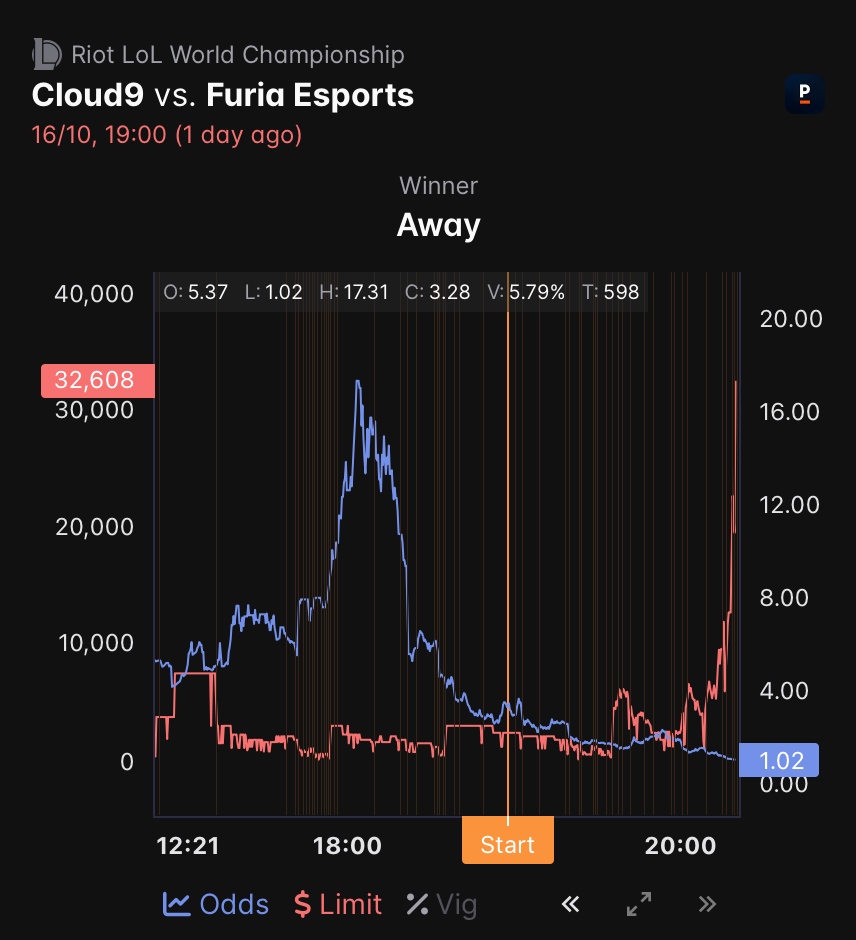
Pinnacle opened FURIA at 5.37. About an hour before the start, the price shot up to 17.31. Then it fell back just as fast and was around 3.28 when the match began. FURIA won the series 3-1, and the price ended at 1.02.
Timing matters more in esports than in bigger markets. The window between a big move and the soft book update can be short. If you check prices once a day, you will usually see the corrected price and not the old one.
What to Watch For
- Stand-in announcements. Check team social accounts in the hours before a match.
- Patch release days. Watch the first week of matches on a new patch.
- Map pool updates. In CS2 and Valorant note which teams lose or gain a strong map.
- Lower-tier leagues. Soft books may price these with less care and update them more slowly.
- Stake limits. A limit is the maximum amount a bookmaker lets you bet. Some soft books lower limits on accounts that often bet esports value.
There is one more thing to keep in mind. Sharp prices in very small esports leagues carry less information because less money is bet on them. A gap between a soft and a sharp price there is less reliable than the same gap in a top league.
FAQ
Why Do Soft Books React Slowly to Esports News?
Esports markets get less betting money than major sports. Soft books often update these prices by hand or from simple models. That leaves old prices open for longer after a roster or patch change.
Does a Stand-In Always Make a Team Weaker?
Usually but not always. The size of the change depends on who is missing and who replaces them. Watch how the sharp price moves to judge it.
How Long After a Patch Should I Watch for Value?
The first matches on a new patch are where soft prices lean most on old results. Keep watching while teams are still adapting. The exact length depends on the game and the patch.
Are Sharp Prices Reliable in Small Esports Leagues?
Less than in big leagues. Fewer bets mean sharp books have less information to set their price. Treat value in very small leagues with more caution and smaller stakes.
Can I Use the Same Method for CS2, LoL, Dota 2 and Valorant?
Yes. Comparing soft prices with de-vigged sharp prices works the same in all four. What changes is the news you follow. Map pools matter most in CS2 and Valorant. Hero and champion changes matter most in Dota 2 and LoL.
Keywords: esports value betting · CS2 betting · LoL betting · Dota 2 betting · Valorant betting · roster news · patch changes · soft bookmakers · dropping odds · de-vigged odds