
Back to Blog
What the Odds Got Wrong About Man City vs PSG
October 22, 2026
On October 14, 2026, Manchester City hosted Paris Saint-Germain at the Etihad Stadium in the Champions League. It was not a normal match.
Weeks earlier a Premier League tribunal found City guilty on charges of financial rule-breaking. Pending sanctions could force the club out of European competition for years. City is appealing but the verdict still landed and this was their first home Champions League game since it happened.
PSG arrived as the two-time defending champion, unbeaten in 10 straight Champions League matches against English clubs. A record European home crowd of 60,021 showed up.
By full time, PSG had won 4-2. City trailed 3-0 at halftime after PSG scored twice in 99 seconds. Erling Haaland pulled two goals back in the second half and became City’s all-time top scorer in the competition. PSG goalkeeper Gianluigi Donnarumma saved a late penalty from Ferran Torres to seal it.
This post is not about the result. It is about what the odds said before kickoff, and why that is worth understanding even if you never bet on this exact match.
The Market Price Before Kickoff
BetUnfair’s Graph Center shows the real price movement on Pinnacle before kickoff. Pinnacle is the sharp book most serious bettors watch first.
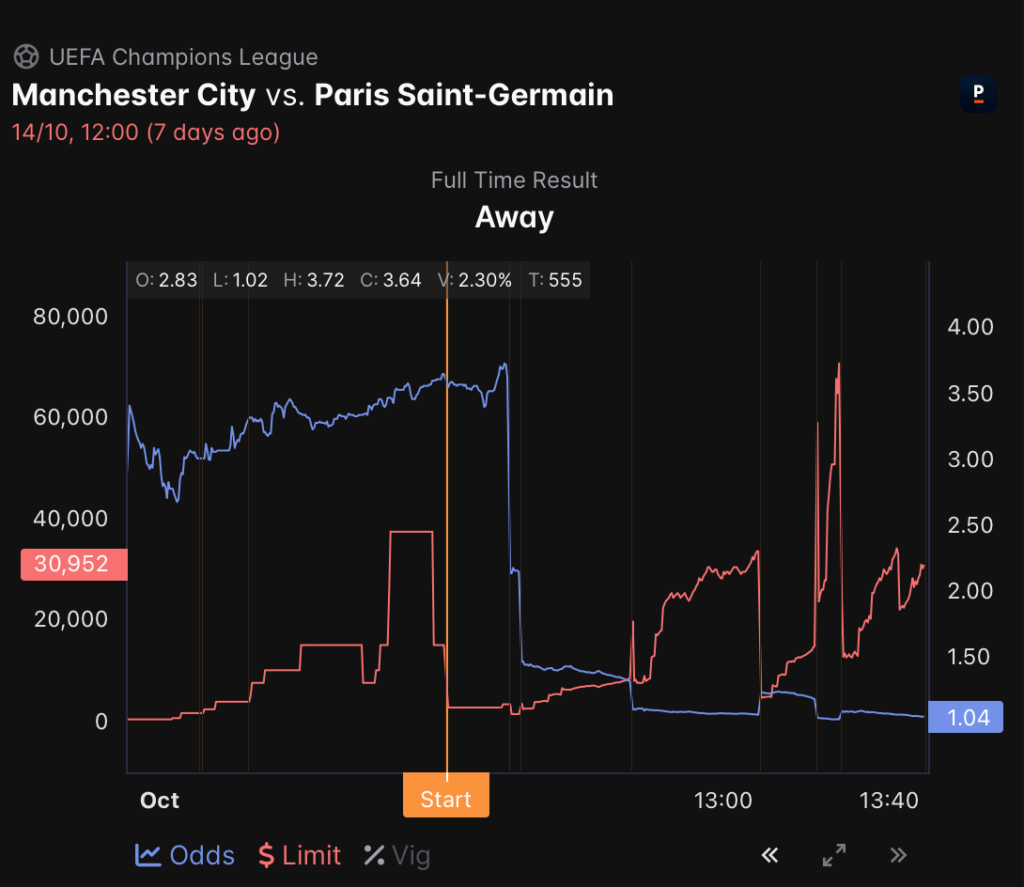
On the Full Time Result market PSG to win opened at 2.83 and closed at 3.64 right before kickoff. The vig on that close was just 2.30%. That’s normal for a sharp book like Pinnacle. A price of 3.64 means the market gave PSG only about a 27% chance to win outright.
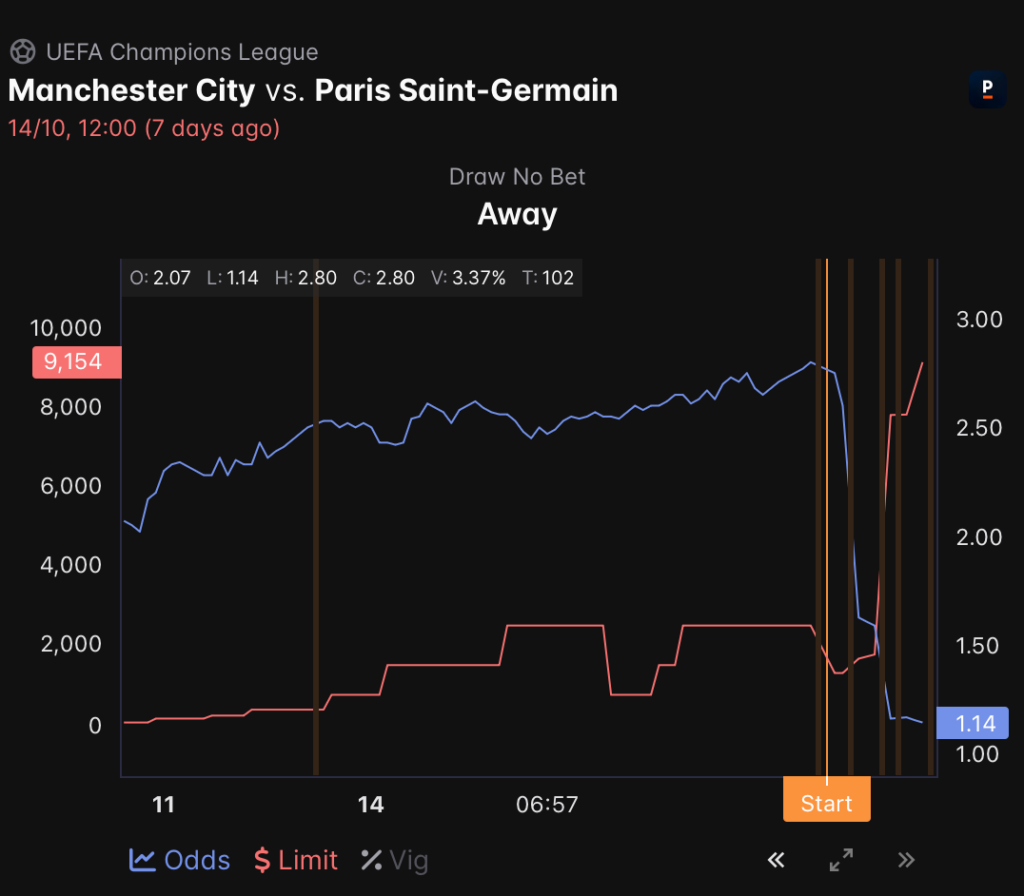
Draw No Bet removes the draw as an outcome. Your stake just comes back if the match ends level. On that market PSG closed at 2.80 with a 3.37% vig. That works out to about a 36% chance of PSG winning once the draw is taken out of the picture.
Either way you look at it, PSG went into this match priced as the clear underdog. That’s despite facing a Man City side missing its manager of nine years and playing its first home game since a guilty verdict in a major financial scandal.
Why the Price Didn’t Match What Actually Happened?
This is the part worth sitting with. On paper, PSG had the stronger case. They are the two-time defending champion. They were unbeaten in 10 straight games against English teams. City, by contrast, had just lost its manager of nine years and was mid-table in a 36-team group stage, playing its first home game under the shadow of a guilty verdict.
Yet the price still leaned toward City.
A home crowd of 60,021, the biggest European crowd City has ever had, creates real pressure on a line. Public money tends to follow the home team, the bigger name, or the team with the emotional story, not always the team with the better underlying form. A sportsbook has to balance where the public money is landing against what it actually believes is likely to happen, and sometimes the price that results sits closer to the crowd’s expectation than the form table would suggest.
That gap, between what a crowd believes and what a fair price should say, is exactly where a sharp bettor looks for value. Not every gap like this turns into a winning bet. This one didn’t, City lost 4-2. But spotting the gap itself, before kickoff, is the actual skill. The result afterward doesn’t tell you whether the price was wrong. It just tells you what happened in one match.
How to Check This Yourself Next Time?
You don’t need to do that de-vig math by hand every time. BetUnfair’s Margin and De-Vig tools do it instantly, so you can see a book’s fair price the moment you load a match. The EV Comparison tool goes a step further and checks that fair price against multiple soft books at once, so you can see exactly where a gap like this one is sitting.
If a price like City’s had started moving in the hours before kickoff, say, drifting shorter as public money piled in, BetUnfair’s Dropping Odds Alerts would have flagged that move the moment it happened. Graph Center then lets you look back at exactly how the price moved all the way into kickoff, not just where it landed.
None of these tools tell you who will win. They tell you what the market actually believes, stripped of the vig and the crowd noise, so you can decide for yourself whether the price in front of you makes sense.
The Takeaway: Man City lost 4-2 at home while still priced as the favorite, in their first match back since a guilty verdict in one of the biggest financial scandals in the sport. The scoreline made headlines. The price is the part worth remembering. Checking a fair price before you bet, not just reading the headline, is what separates a bet based on a story from a bet based on value.
Want to check a fair price yourself before the next big match?
Start your 5-day free trial at betunfair.io
FAQ
What does -110 mean in betting odds?
It means you need to bet 110 to win 100 in profit. Odds with a minus sign always show a favorite.
What is Draw No Bet?
A two-way market used in soccer where your stake is refunded if the match ends in a draw, instead of losing the bet outright.
What does de-vigging odds mean?
It means removing a bookmaker’s built-in profit margin from a price, so you can see the fair probability the book actually believes in, not the inflated one it charges you.
Why did Man City stay a favorite despite the scandal?
A home crowd of over 60,000 and strong public betting interest can keep a price shorter than the underlying team form might suggest, since bookmakers balance where the money is landing against their own model.
Does a betting favorite losing mean the price was wrong?
Not necessarily. A fair price reflects probability, not certainty. A 50% favorite is expected to lose half the time. One result never proves or disproves a price on its own.
Keywords: sports betting · sports betting apps · best sports betting app · online sports betting · value betting · de-vig odds · implied probability · Champions League betting · moneyline betting · draw no bet