
Back to Blog
Steamers and Drifters: What a Moving Price Tells You
November 2, 2026
Every football price moves before kick-off. Some prices fall and some rise. Bettors have a name for each. A price that falls is a steamer. A price that rises is a drifter.
The words come from horse racing. A horse “steamed” when a lot of money came in on it and its price dropped fast. The idea is simple. But it leads to a question worth asking. When a price moves, does the move tell you who is more likely to win?
What is a Steamer?
A steamer is a selection whose price gets shorter before the event starts. Shorter means lower odds.
Say a team opens at 2.40 and starts the match at 2.10. That team steamed. To see what the move means, turn each price into a chance. You do this by dividing 1 by the price. At 2.40 the chance is about 41.7%. At 2.10 it is about 47.6%. The market now rates the team about six points more likely to win than it did at the open.
What is a Drifter?
A drifter is the opposite. Its price gets longer, which means higher odds. A team that opens at 3.20 and starts at 3.60 drifted. Its chance went from about 31.3% to about 27.8%.
In a market with three outcomes, a steamer on one side usually means a drifter somewhere else. The chances have to add up to roughly 100%, plus the bookmaker’s margin. So if one chance goes up, another has to go down.
Why Do Prices Steam or Drift?
There are three common reasons.
- News. A team sheet, an injury or a rested star player changes the real chance of each result.
- Money. Sharp bookmakers like Pinnacle move their price when bets arrive from players they respect.
- Correction. Sometimes the opening price was just wrong, and the market fixes it over the day.
Not every move carries the same weight. A move early in the week, when the bookmaker’s limit is small, costs the book very little to make. We cover that in Low Limits, Loud Odds.
How to Read a Steamer on a Chart
A price chart has two lines. The blue line is the price. The red line is the limit, which is the biggest bet the bookmaker will take at that price. A steamer shows up as the blue line stepping down. A drifter shows up as the blue line stepping up.
Look at three things on the chart:
- Where the price started. This is the opening price.
- How it moved. One sharp step usually means one piece of news or one big bet. A slow slide usually means steady money over many hours.
- What the limit was when it moved. A move made with a high limit means the bookmaker is ready to take real money at the new price. That is a stronger move than one made with a small limit.
A Real Example: Atletico de Rafaela v Patronato
This example came straight from the BetUnfair Dropping Odds alert feed on the morning of November 2. Two hours before kick-off, an alert fired on Atletico de Rafaela to win at home in Argentina’s Primera Nacional. Pinnacle had cut the price by 24% to 1.86. We opened the match in the Graph Center to see how it got there.
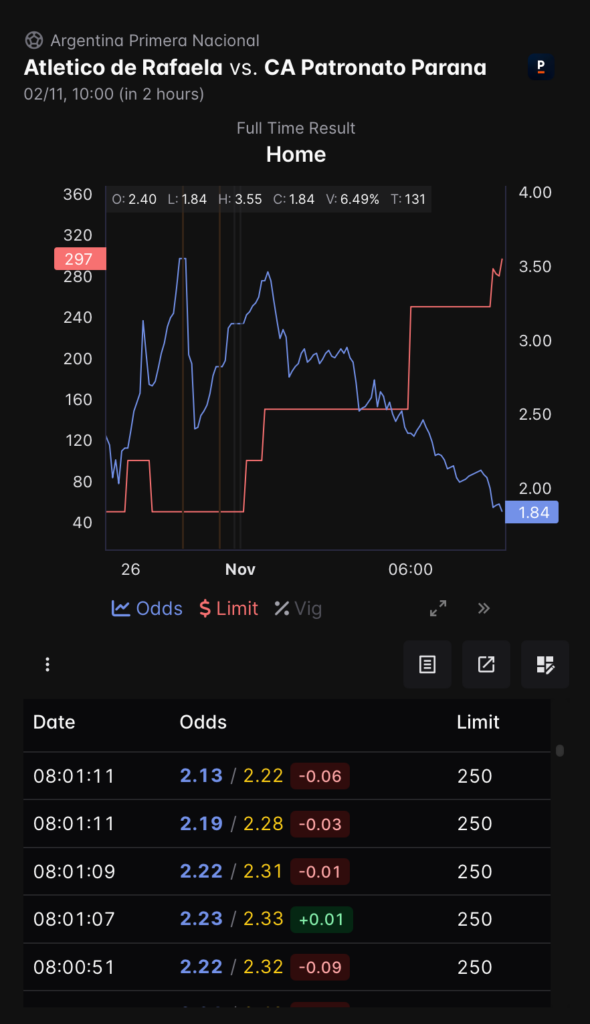
Figure 1: Atletico de Rafaela v CA Patronato Parana (Argentina, Primera Nacional), Full Time Result, Home. Pinnacle price (blue) and limit (red).
| Point on the chart | Pinnacle price | Chance | Limit |
| Opening price | 2.40 | 41.7% | 50 |
| Highest price (Oct 29) | 3.55 | 28.2% | 50 |
| When the alert fired (Nov 2) | 1.86 | 53.8% | 297 |
| Closing price (kick-off) | 1.68 | 59.5% | 475 |
The same team was a drifter first and a steamer second.
The drift. Early in the week the home price climbed from 2.40 to 3.55. On paper that is a big move. The market went from rating the home side at about 42% to about 28%. But look at the red line. The limit during that climb was only 50. Pinnacle was not taking big bets yet, so the price could swing a long way on very little money. The price jumped up and down again more than once in those first days.
The steam. The second move looks different. From around November 1, the price began to fall steadily. This time the limit rose with it, from 50 to 100, then 150, then 250, and close to 300 by the time the alert fired. Every step down in price came with Pinnacle willing to take a bigger bet. By kick-off the home side was 1.68, a chance of about 60%.
If you only looked at the opening and closing prices, you would see a team that went from 2.40 to 1.68. A normal steamer. The chart shows the real story. The loud move came first on a small limit. The real move came later, with the money behind it.
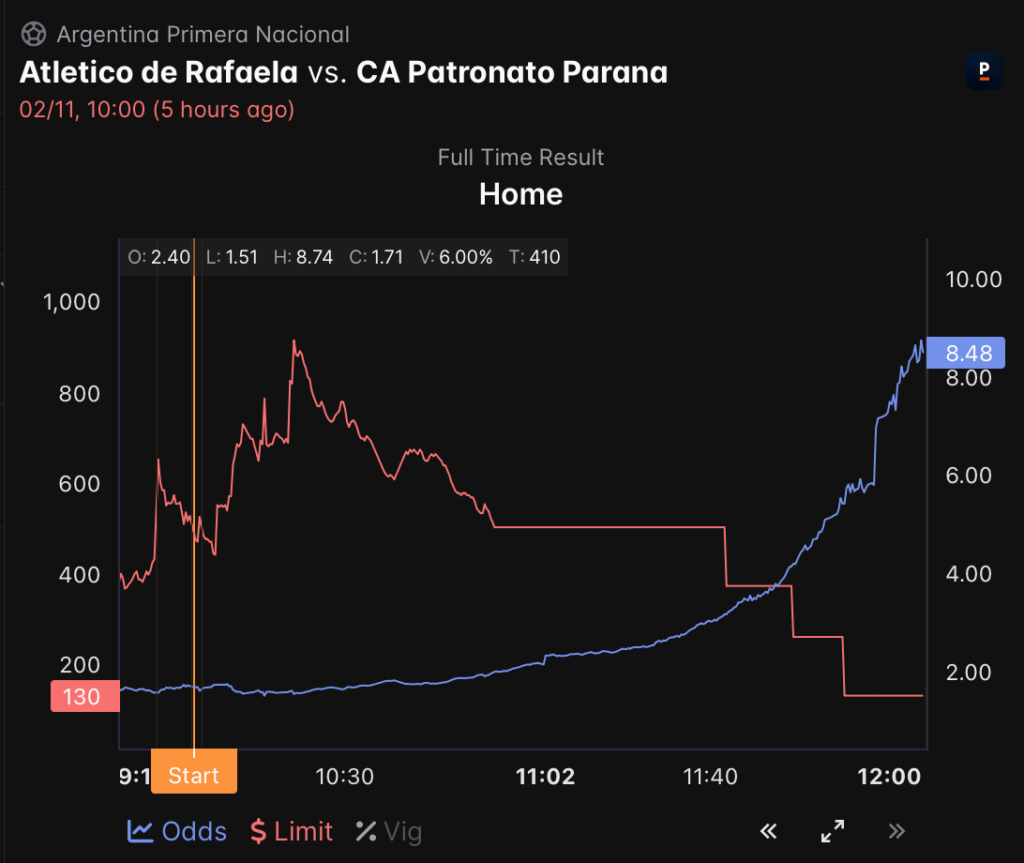
Figure 2: Atletico de Rafaela v CA Patronato Parana, Full Time Result, Home. Pinnacle price and limit after kick-off.
The second chart shows what happened once the match started. The home price climbed slowly at first and then quickly, to 8.48 near the end. In play, a price that rises like that means the goal the market expected never came. The match finished 0-0.
Keep in mind that one match tells you very little. At kick-off the home side had a chance of about 60%. That left about 40% for a draw or an away win, which is far from nothing. A steamer can lose and a drifter can win. The question is what happens over hundreds of matches.
What This Means for Your Bets
- The value is before the move, not after it. If you take 1.68 once the team has already steamed, you get the new price. The bettors who took 2.40 or higher got the value.
- Check the limit before you trust the move. The early drift in our example happened on a 50 limit. The steam happened as the limit rose to nearly 300. Our post on the Three Signals that mean a sharp book just changed its mind covers what else to look for.
- Soft books are often slower. Pinnacle may have moved while a soft bookmaker still shows the old price. That gap is the bet. This is the whole idea behind dropping odds.
- A drifter is not a bet to avoid. It only tells you the market rates it lower than before. At the right price it can still be good value.
- Check your closing line value. If the teams you back keep steaming after you bet, you are beating the closing price. That is the clearest sign your bets are good. Our guide on How to read Odds Movement goes into more detail.
Catch the Steamer as It Starts
The alert in this post came from BetUnfair’s Dropping Odds feed. It tells you the moment a sharp book cuts a price, across up to 17 sharp bookmakers. Open the match in the Graph Center and you see the full move with the limit next to it. Then you can check if a soft book still has the old price before it catches up.
Set up your first Dropping Odds alert at betunfair.io. Every plan comes with a one-month money-back guarantee, so you can test it on real matches before you decide.
FAQ
What is a steamer in betting?
A steamer is a selection whose odds fall before the event starts. It usually means money or news has made the bookmaker think that result is more likely.
What is a drifter in betting?
A drifter is a selection whose odds rise before the event. The market now rates that result less likely than it did when the price opened.
Should I bet on steamers?
Only if you can get the price before it falls, or at a soft book that has not moved yet. Backing a steamer at its new, lower price gives you none of the value from the move.
Is a steamer the same as dropping odds?
Yes. Dropping odds is the more common name today. Both describe a price that has been cut by the bookmaker.
Can a team drift and then steam?
Yes. Our example did exactly that. It drifted from 2.40 to 3.55 early in the week and then steamed to 1.68 by kick-off. The limit at each stage tells you which move to trust.
Keywords: steamers and drifters · what is a steamer in betting · what is a drifter in betting · steamer odds · drifting odds meaning · dropping odds explained · odds movement football